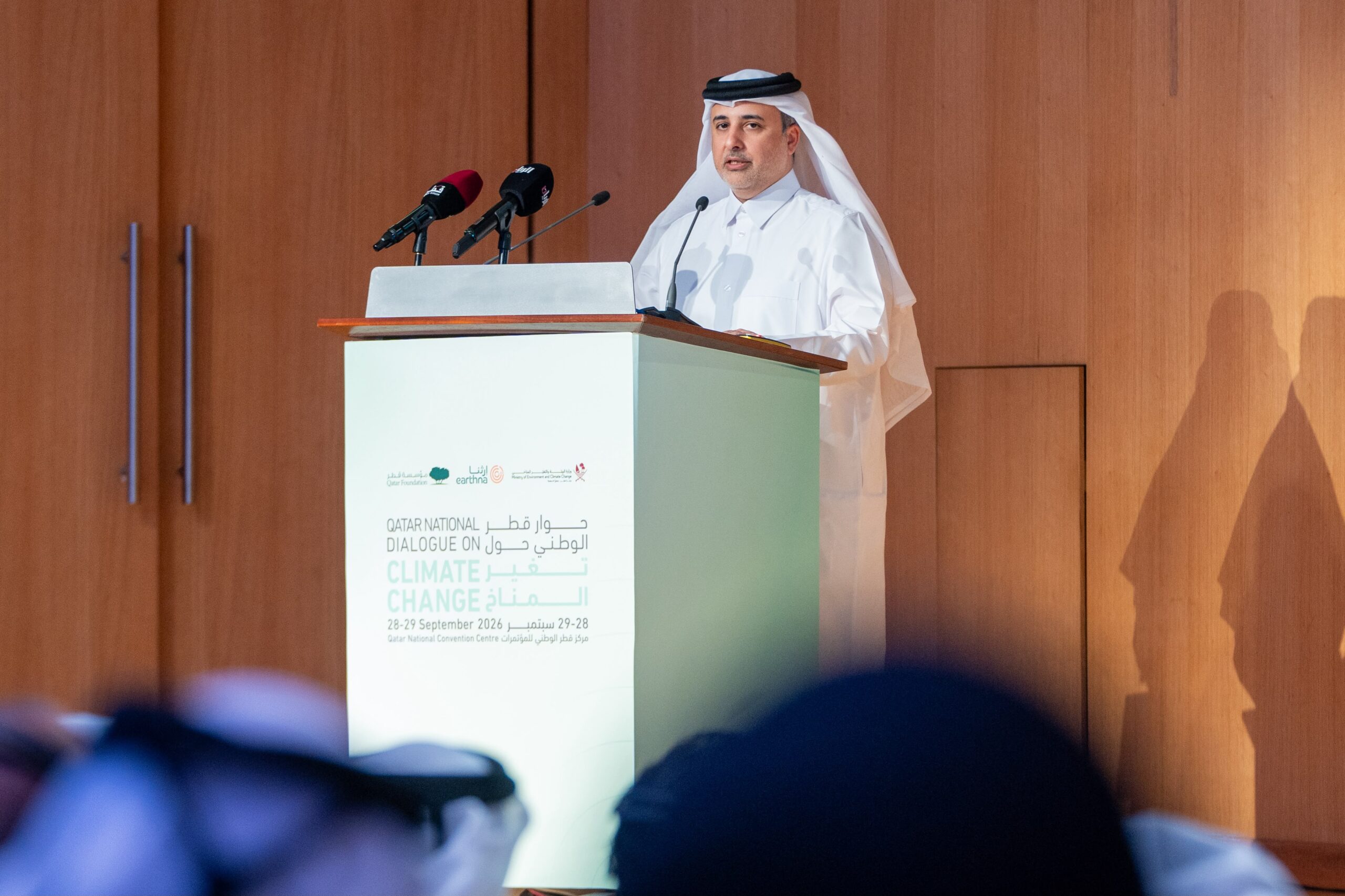
The sixth edition of the “Qatar National Dialogue on Climate Change” kicked off today under the theme “Enhancing Climate Adaptation in the State of Qatar: From Planning to Implementation.” The dialogue is organized by the Ministry of Environment and Climate Change in partnership with Earthna: Center for a Sustainable Future, a member of Qatar Foundation, with the participation of representatives from government entities, the private sector, and academic and research institutions, as well as a number of experts and specialists.
The dialogue discusses ways to implement the National Adaptation Plan and the challenges associated with its implementation through discussion sessions covering six areas: water; energy and industry; agriculture and food systems; infrastructure and coastal areas; public health; and biodiversity.
In his opening remarks, HE Dr. Abdullah bin Abdulaziz bin Turki Al Subaie, Minister of Environment and Climate Change, affirmed that the current phase requires moving from developing climate change adaptation plans to implementing them and coordinating efforts to achieve tangible results, in light of the accelerating climate changes taking place around the world.
His Excellency said that preparing for the impacts of climate change has become an essential part of planning for the future, protecting resources, enhancing the preparedness of various sectors, and preserving quality of life for future generations.
He explained that the State of Qatar has placed environmental protection and sustainability among its national priorities, under the wise leadership of HH Sheikh Tamim bin Hamad Al Thani, Amir of the State, and that the Qatar National Vision 2030 has emphasized the importance of achieving a balance between development requirements, environmental and resource protection, and the rights of future generations.
HE the Minister of Environment and Climate Change noted that developing the National Adaptation Plan for Climate Change represents an important step in this direction, given the links between adaptation, multiple sectors, and the country’s development journey. He stressed that implementing the plan requires clearly defining the role of each entity and the means of cooperation among them.
He highlighted the interconnected nature of work across these sectors, noting that water is linked to food, energy to industry, and infrastructure to the ability of cities and coastal areas to withstand the impacts of climate change. Public health is also linked to the environment, while biodiversity is connected to the sustainability of natural ecosystems. He affirmed that successful adaptation efforts require cooperation among government and quasi-governmental entities, the private sector, academic and research institutions, and civil society.
HE the Minister stressed the importance of discussing practical ways to address challenges and making use of knowledge and expertise in taking actionable decisions and measures. He said: “The value of plans is measured by the impact they create, and the value of dialogue is measured by the action it leads to.” He also expressed his hope that the sessions would result in a clearer identification of priorities and responsibilities, as well as practical steps that can be built upon after the conclusion of the dialogue.
For his part, Eng. Ahmed Mohammed Al Sada, Assistant Undersecretary for Climate Change Affairs at the Ministry of Environment and Climate Change, affirmed that the Ministry, in cooperation with Earthna Center, was keen to ensure that the dialogue sessions were aligned with the National Adaptation Plan and addressed the needs of the relevant entities and the challenges they face during implementation.
He said that dedicating discussion sessions to the six areas provides an opportunity to examine the needs of each area in detail and benefit from the expertise of government entities, the private sector, and academic and research institutions in defining roles and identifying avenues for cooperation among them.
He explained that the Ministry looks forward to recommendations identifying the steps required in each area. The outcomes of the sessions will be documented to capture the key conclusions reached by participants and utilize them to enhance coordination among relevant entities in support of the implementation of the National Adaptation Plan, in addition to preparing for the State of Qatar’s participation in the 31st Conference of the Parties (COP31).
For his part, Dr. Gonzalo Castro de la Mata, Executive Director of Earthna, affirmed that the National Adaptation Plan sets out a clear direction for enhancing the State of Qatar’s capacity to address the impacts of climate change, noting that this year’s dialogue focuses on translating the objectives of the plan into practical actions coordinated among the relevant entities.
He explained that the discussion sessions provide an opportunity to benefit from specialized research and expertise, discuss implementation challenges across the six areas, and identify the roles of participating entities, with the aim of reaching recommendations that support Qatar’s efforts to adapt to climate change.
He noted that Earthna draws on Qatar Foundation’s research, innovation, and policy ecosystem to contribute to translating knowledge into practical solutions. He considered the dialogue part of the Foundation’s sustainability-supporting initiatives, as it brings together expertise from different sectors, connects research with decision-making, and supports the development of solutions in Qatar that could also benefit other hot and arid regions.
Source: Sixth Edition of the Qatar National Dialogue on Climate Change Kicks Off